
About the author
James Okonkwo
Horticulturist & Plant Identification Specialist
James holds a B.Sc. in plant science and has led community plant-ID workshops across the UK. He focuses on field identification, invasive species awareness, and how AI tools fit alongside traditional botany.
Ever Wonder Why Leaves Look So Different?
A leaf's shape isn't just for show-it's a clue to its identity and survival strategy. As the experts at ePlant AI, we know that understanding these shapes is the first step to becoming a true plant whisperer. And when you're ready to put your knowledge to the test, our app is here to help.
Identify Leaves with ePlant AILeaves are a plant's solar panels and lungs, perfectly adapted to their environment. By learning to recognize their shapes, you're not just identifying a plant; you're reading a story of evolution. This guide, brought to you by the team at ePlant AI, will introduce you to the most common leaf shapes, transforming the way you see the green world around you.
Basic Leaf Shapes: The Building Blocks
Let's start with the fundamentals. Many leaves you encounter will fall into one of these simple categories.
Oval
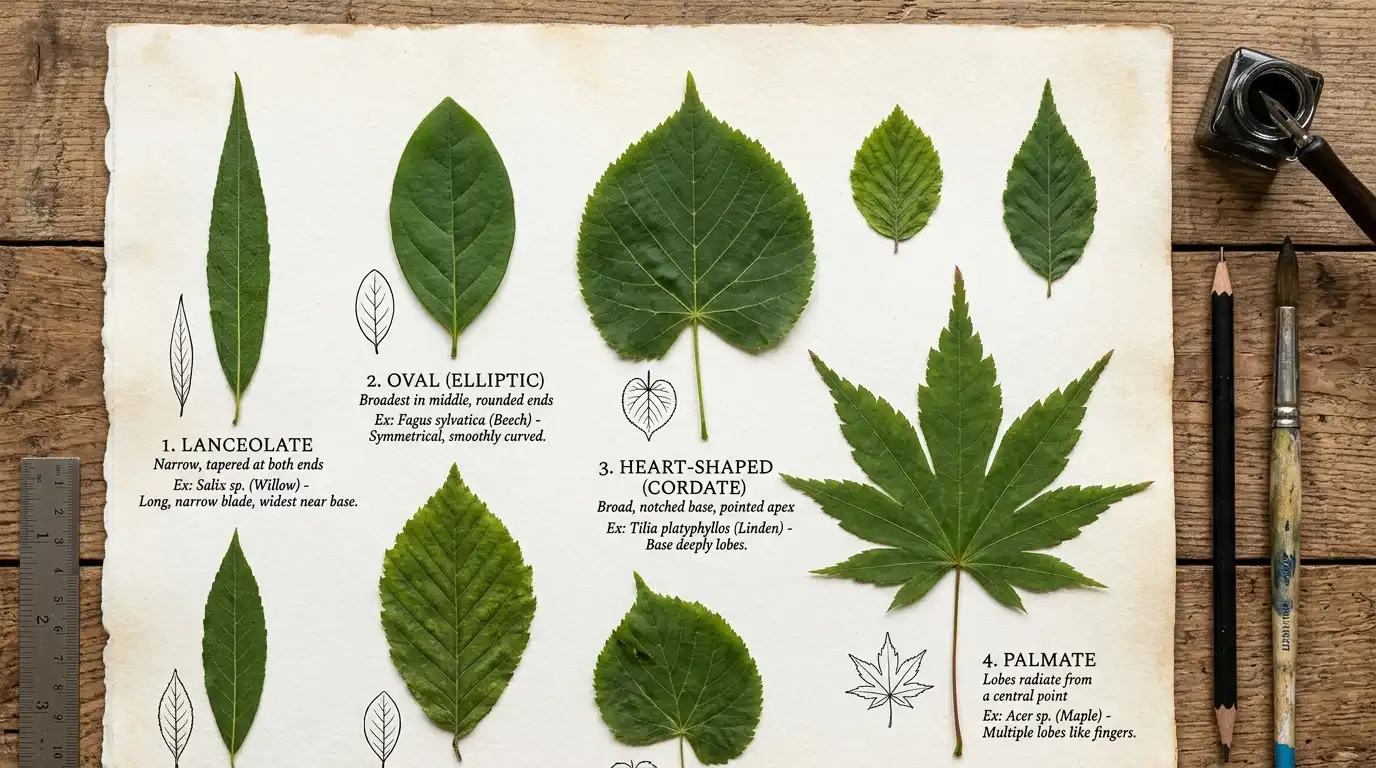
Shaped like an egg, but broad and rounded at both ends. Think of the classic leaf shape you drew as a child. Many common shrubs and trees, like Dogwood, have oval leaves.
Round (Orbicular)
These leaves are circular, like a coin. The Pilea Peperomioides, or "Pancake Plant," is a perfect example, showcasing its charming, round foliage.
More Complex Shapes
Ready for the next level? These shapes add a little more character and are key identifiers for many popular plants.
Heart-Shaped (Cordate)
As the name suggests, these leaves are shaped like a heart, with a notch at the base where the stem attaches. The beloved Heartleaf Philodendron is a classic example.
Lance-Shaped (Lanceolate)
Long and narrow, wider in the middle and tapering to a point at both ends, like the tip of a spear. The leaves of a Snake Plant (Sansevieria) are a great example.
Lobed
Lobed leaves have distinct protrusions or deep indentations. The classic example is the Oak leaf, with its deep, rounded lobes that make it instantly recognizable.
Fan-Shaped (Palmate)
These leaves are divided into several lobes or smaller leaflets that radiate from a single point, resembling the fingers of an open hand. A Japanese Maple leaf is a beautiful palmate example.
Did You Know?
A leaf's shape can tell you about its native climate. For example, plants from dry climates often have small, needle-like leaves to conserve water, while plants from shady rainforests often have large, broad leaves to capture as much sunlight as possible.
Putting It All Together
Now that you know a few basic shapes, you can start combining this knowledge with other clues like color, texture, and leaf arrangement to become a master identifier.
But you don't have to do it alone. The world of plants is vast and complex, and that's where we come in. At ePlant AI, we've trained our AI on millions of images to recognize these subtle differences for you. When you're out on a walk and see a leaf you don't recognize, simply snap a photo.
Ready to Become an Expert Identifier?
Turn your newfound knowledge into action. Download the ePlant AI app and start identifying the leaves, flowers, and trees in your neighborhood today.
Start Identifying with ePlant AI for FreeFrequently Asked Questions
What's the difference between a simple and a compound leaf?
A simple leaf has a single, undivided blade (though it can be lobed). A compound leaf is divided into multiple smaller leaflets. The palmate shape is one type of compound leaf.
How does the ePlant AI app identify a leaf?
Our AI analyzes much more than just the basic shape. It looks at the leaf margin (the edge), the vein pattern, the texture, and the color, comparing it against a massive database to find the most accurate match in seconds.