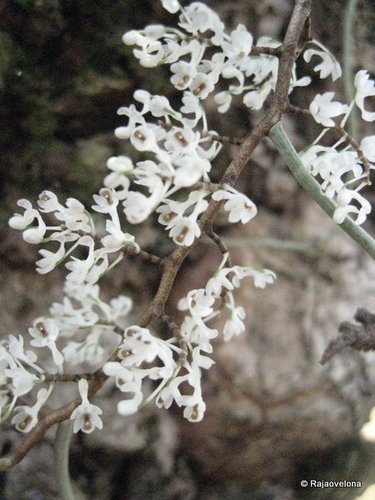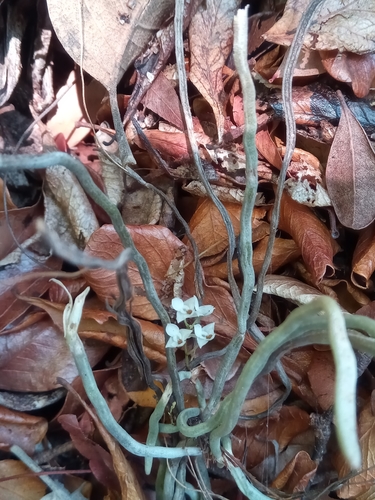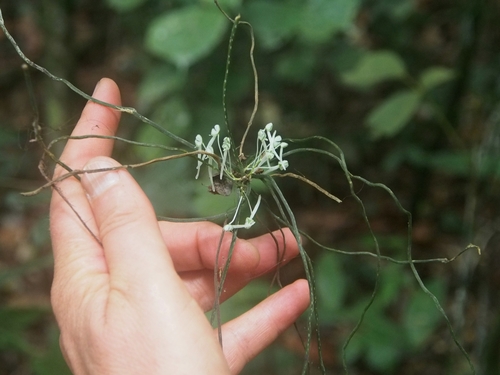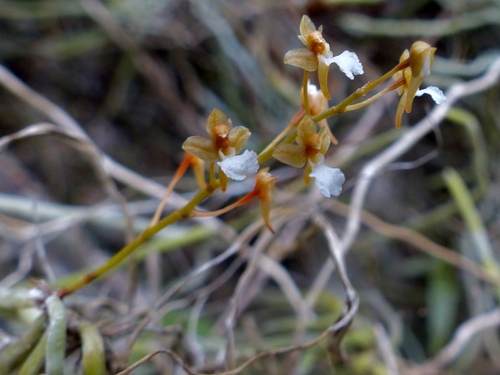
Microcoelia hirschbergii is a leafless orchid from tropical Africa, known for its unusual appearance and epiphytic growth habit.
Microcoelia hirschbergii is a fascinating orchid species, notable for its unique growth habit and delicate floral display. As a member of the Microcoelia genus, it shares characteristics with other leafless orchids, presenting a distinct botanical interest. This species is primarily recognized for its epiphytic nature and its specialized adaptations to its environment.
Physically, Microcoelia hirschbergii is characterized by its lack of true leaves. Instead, its photosynthetic activity is carried out by its extensive, silvery-green roots, which adhere to the surfaces of host trees. These roots are flattened and broad, maximizing their surface area for light absorption and nutrient uptake. The plant typically forms a tangled mass of these roots, often appearing as a silvery mat on its substrate. The inflorescences emerge from the root mass, bearing small, ephemeral flowers. The flowers are typically white or pale green, with a delicate structure. Specific details regarding the size and exact morphology of the flowers, fruits, and seeds are best observed in situ or through detailed botanical illustrations and specimens, as these ephemeral structures are not always readily described in general horticultural literature.
The native distribution of Microcoelia hirschbergii is within specific regions of Africa. It thrives in humid, tropical environments, typically found in lowland forests and woodlands. Its natural habitat is as an epiphyte, growing on the bark of mature trees, where it receives filtered sunlight and benefits from the moisture and nutrients carried by air currents and rainfall. Cultivation of Microcoelia hirschbergii requires replicating these specific conditions. It necessitates excellent air circulation, high humidity, and bright, indirect light. It should be mounted on a suitable substrate, such as cork bark or tree fern, allowing its roots to spread freely. Watering should be done judiciously, allowing the roots to dry slightly between waterings, and a balanced orchid fertilizer can be applied during the growing season.
While not widely cultivated for ornamental purposes due to its specialized needs and subtle beauty, Microcoelia hirschbergii holds significance within botanical circles for its unique adaptations. Its leafless nature is a remarkable evolutionary strategy, allowing it to thrive in environments where traditional foliage might be a disadvantage. The photosynthetic roots are a testament to the diverse ways plants have evolved to capture energy. Further research into its ecological interactions and potential biochemical properties may reveal additional areas of importance, but currently, its primary recognition stems from its botanical curiosity and its place within the study of orchid diversity. Its existence highlights the intricate relationships between plants and their environments, showcasing nature's ingenuity in adapting to varied ecological niches.
Requires an extremely well-draining epiphytic mix, such as orchid bark, charcoal, and perlite.
Temperature
Warm to intermediate temperatures.
Habitat
Greenhouse, Indoor
Fertilizer
Feed during growing season.
Care Requirements
Light
Bright, indirect light.
Avoid direct sun.
Water
Water when dry, ensure good drainage.
Reduce slightly in cooler months.
Soil
Requires an extremely well-draining epiphytic mix, such as orchid bark, charcoal, and perlite.
Temperature
Warm to intermediate temperatures.
Day: 20-28°C, Night: 15-20°C.
Habitat
Greenhouse, Indoor
Fertilizer
Feed during growing season.
Use diluted orchid fertilizer.
Plant Overview
Plant Type
Vine
Plant Category
Ornamental
Plant Place Type
Hanging
Plant Environment
Greenhouse, Indoor
Lifespan
Perennials
Plant Height
0.1-0.3 m
Spread
0.1-0.3 m
Growth Rate
Slow
Dormancy
None
Leaf Type
Leafless
Flower Size
2-3 cm
Image Gallery
Flowering & Fruiting Cycles
Monthly activity intensity for bloom and fruit across both hemispheres.
Northern hemisphere
Flowering & fruiting calendar
Peak bloom · JulPeak fruit · Aug
FloweringFruiting
Southern hemisphere
Flowering & fruiting calendar
Peak bloom · MayPeak fruit · Jun
FloweringFruiting
Taxonomy
kingdomPlantae
divisionTracheophyta
classLiliopsida
orderAsparagales
familyOrchidaceae
genusMicrocoelia
speciesMicrocoelia hirschbergii
Toxicity
Toxic for humans
No
Rating: 0/5
Toxic for pets
No
Rating: 0/5
Edible
No
Additional Care Tips
Water thoroughly when the potting medium is dry, typically once every 7-10 days. Reduce watering slightly during cooler periods. Ensure good drainage to prevent root rot.
Pruning is generally not required. Remove any dead or damaged roots or stems carefully with sterile tools to maintain plant health and prevent disease spread.
Propagation is typically done by division of mature plants during repotting. It is a slow process and requires patience and careful handling of the root system.
Repot every 2-3 years or when the potting medium breaks down. Use a coarse, well-draining epiphytic mix and a pot that allows for good air circulation around the roots.
FAQs
Why is Microcoelia hirschbergii leafless?
This orchid is leafless, with its green, succulent roots adapted to perform photosynthesis, a unique adaptation to its epiphytic environment.
What kind of light does Microcoelia hirschbergii need?
It requires bright, indirect light. Direct sunlight can be too intense and damage its roots and stem, so filtered light or placement away from direct sun is crucial.
How often should I water Microcoelia hirschbergii?
Water thoroughly when the potting medium is dry, typically every 7-10 days. Ensure excellent drainage to prevent root rot, as it is sensitive to overwatering.
Can Microcoelia hirschbergii be grown outdoors?
It is generally best grown indoors or in a greenhouse in a tropical or subtropical climate. It requires high humidity and protection from cold temperatures and direct sun.
What is the best potting mix for Microcoelia hirschbergii?
An extremely well-draining epiphytic mix is essential. Common components include orchid bark, charcoal, and perlite to ensure good aeration and prevent waterlogging.