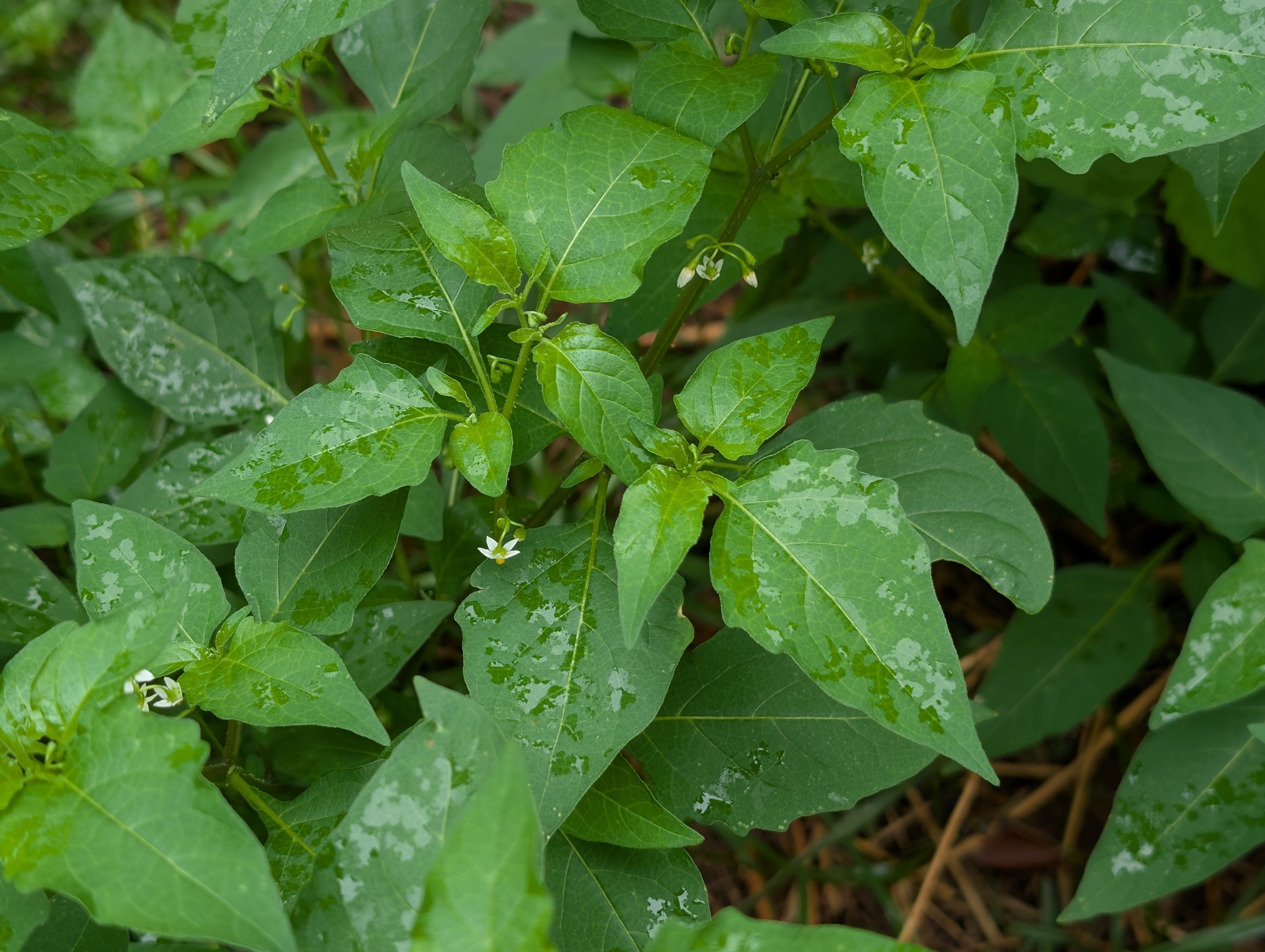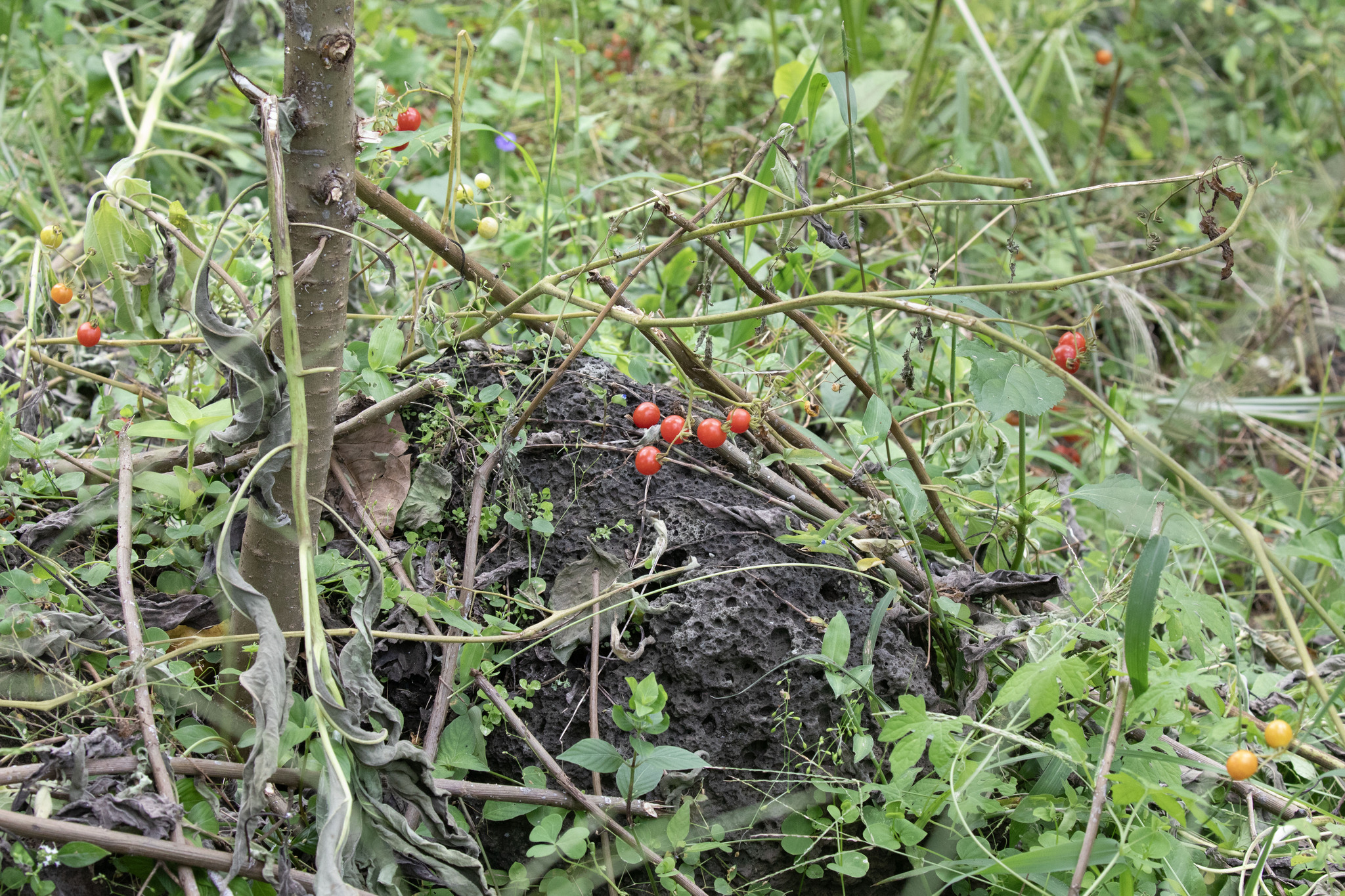
Turkey Berry (Solanum torvum) is a fast-growing shrub native to the Americas, bearing small, white flowers and clusters of green berries that turn yellow when ripe.
Solanum torvum, commonly known as Turkey Berry, is a species of flowering plant in the nightshade family, Solanaceae. This versatile plant holds significance in various regions for its ecological role and traditional uses.
Physically, Solanum torvum is a shrub that typically grows to a height of one to three meters, though it can occasionally reach up to five meters. Its growth habit is erect and somewhat bushy. The stems are woody at the base and often covered with stellate (star-shaped) hairs and prickles, which can be straight or slightly curved and are typically yellowish. The leaves are ovate to broadly ovate, measuring between 7 to 20 centimeters long and 4 to 15 centimeters wide. They are arranged alternately on the stem and are often lobed or irregularly toothed, with a velvety texture due to dense stellate hairs on both surfaces. The flowers are borne in lateral, cymose inflorescences and are typically white or pale violet, with five pointed petals and prominent yellow anthers. The fruit is a globose berry, about 1 to 2 centimeters in diameter, which is green when immature and ripens to a yellow or orange-yellow color. Each berry contains numerous small, flattened seeds.
The native distribution of Solanum torvum is widespread across tropical and subtropical regions of the Americas, including the Caribbean, Central America, and South America. It has also naturalized and become established in many other parts of the world, including Africa, Asia, and Oceania, often in disturbed habitats. This species thrives in a variety of natural habitats, including open woodlands, savannas, grasslands, and along roadsides. It prefers well-drained soils and can tolerate a range of soil types, from sandy to clayey. Cultivation requirements generally involve full sun to partial shade and moderate watering.
Solanum torvum possesses notable biological and ecological importance. It serves as a food source for various wildlife and can act as a pioneer species, colonizing disturbed areas. Ecologically, it contributes to biodiversity in its native and introduced ranges. Beyond its ecological role, Solanum torvum has a history of traditional uses. In some cultures, the fruits and leaves have been utilized in folk medicine for various ailments, though scientific validation of these uses is ongoing and requires rigorous research. The plant's fruits are also consumed in certain culinary traditions, often cooked as a vegetable or used in stews and curries. Economically, it is sometimes cultivated for these purposes in local markets.
An interesting characteristic of Solanum torvum is its ability to adapt to diverse environmental conditions, contributing to its widespread presence. The stellate hairs and prickles on its stems are adaptations that may offer protection against herbivores. The prolific production of small seeds within its berries facilitates its dispersal and colonization of new areas. Its presence in disturbed habitats highlights its resilience and capacity to thrive in human-modified landscapes.
At-a-glance light, water, soil, and growing conditions from plant data
Light
High
100% intensity
Prefers full sun for best growth and fruit production.
Watering
Moderate
50% intensity
Keep soil consistently moist but well-drained.
Soil
Well-drained
50% intensity
Temperature
High
100% intensity
Thrives in warm temperatures, ideal range 20-30°C.
Habitat
Outdoor
50% intensity
Fertilizer
Moderate
50% intensity
Feed during the growing season with a balanced fertilizer.
Turkey Berry Toxicity
Safety information from plant toxicity data
Toxicity details for Turkey Berry
Attribute
Value
Toxic for humans
Yes
3/5 intensity
Toxic for pets
Yes
3/5 intensity
Edible
Yes
Mildly toxic if unripe or consumed in large quantities. Contains solanine.
Turkey Berry Quick Facts
Key traits and growing stats from plant data
Plant Type
Shrub
Plant Category
Fruit
Plant Place Type
Garden, Pot
Plant Environment
Outdoor
Lifespan
Perennial
Plant Height
1-3 m
Spread
1-2 m
Growth Rate
Fast
Dormancy
None
Leaf Color
Green
Leaf Type
Simple
Flower Size
1.5-2 cm
Optimal Sunlight Lux
60000
Weed Status
Yes
Care guide for Turkey Berry
Watering, pruning, propagation, and repotting details from plant data
Water
Water thoroughly when the top 2-3 cm of soil feels dry. Avoid waterlogging, as Solanum torvum prefers consistently moist but well-drained conditions.
Reduce watering slightly during cooler, dormant periods, but do not let the soil become completely dry.
Pruning
Prune to maintain desired shape and size, and to remove any dead, diseased, or crossing branches. Pinch back young plants to encourage bushier growth.
Heavy pruning can be done in late winter or early spring before new growth emerges.
Propagation
Propagate primarily from seeds, which germinate readily under warm, moist conditions. Seeds can be sown indoors 6-8 weeks before the last frost. Cuttings taken from mature plants can also be rooted in moist potting mix.
Repotting
Repot young plants annually or when they become root-bound, typically in spring. Use a well-draining potting mix. Mature plants may only need repotting every 2-3 years. Choose a pot one size larger than the current one.
Identify plants like this with ePlant
Snap a photo to get care tips and match similar species on the go.
Monthly activity intensity for bloom and fruit across both hemispheres.
Northern hemisphere
Flowering & fruiting calendar
Peak bloom · JulPeak fruit · Oct
FloweringFruiting
Southern hemisphere
Flowering & fruiting calendar
Peak bloom · JanPeak fruit · Nov
FloweringFruiting
Image Gallery
Photos of Turkey Berry (Solanum torvum)
Turkey Berry Names & Synonyms
Common names and botanical synonyms
Common Names
Berenjena Cimarrona
Devil's-Fig
Fausse Aubergine
Foulberry Tree
Gully Bean
Pea Eggplant
Platebrush
Pokak
Prickly Nightshade
Prickly Solanum
Sing Khang
Susumber
Talong-Talongan
Terongan
Terung Manggul
Terung Rembang
Turkey Berry
Wild Egg Plant
Wild Eggplant
ఉస్తీకాయ
Synonyms
Solanum acanthifolium Dunal
Solanum amoenum Jungh.
Solanum campechiense Dunal
Solanum crotonoides Michx. ex Dunal
Solanum daturifolium Dunal
Solanum ficifolium Ortega
Solanum largiflorum C.T.White
Solanum macaonense Dunal
Solanum maccai Bertero ex Dunal
Solanum mammosum Herb. ex Dunal
Solanum mannii C.H.Wright
Solanum mayanum Lundell
Solanum obtusifolium Hartw. ex Sendtn.
Solanum sanctum Jan ex Dunal
Solanum silarium Buch.-Ham. ex Wall.
Turkey Berry Taxonomy
Botanical classification
Taxonomic classification of Turkey Berry
Rank
Name
kingdom
Plantae
division
Tracheophyta
class
Magnoliopsida
order
Solanales
family
Solanaceae
genus
Solanum
species
Solanum torvum
Turkey Berry FAQs
Answers based on plant encyclopedia data
What are the cultivation requirements for Solanum torvum?
Solanum torvum thrives in full sun to partial shade and well-drained soil. It prefers warm climates and can tolerate a range of soil types but performs best in fertile conditions.
When should Solanum torvum be pruned?
Pruning is best done in late winter or early spring before new growth begins to shape the plant and remove any dead or damaged branches.
Is Solanum torvum edible?
Yes, the berries of Solanum torvum are edible when cooked. They are often used in stews, curries, and other dishes in various tropical cuisines. Unripe berries can be bitter.
What are common pests and diseases affecting Turkey Berry?
Common pests include aphids and whiteflies. Diseases can include fungal spots and root rot, especially in waterlogged conditions.
Can Solanum torvum be grown in containers?
Yes, Solanum torvum can be grown in large containers with adequate drainage, provided it receives sufficient sunlight and regular watering.